Pantry
Apartment closet pantry: working with 9–12 inch shelves
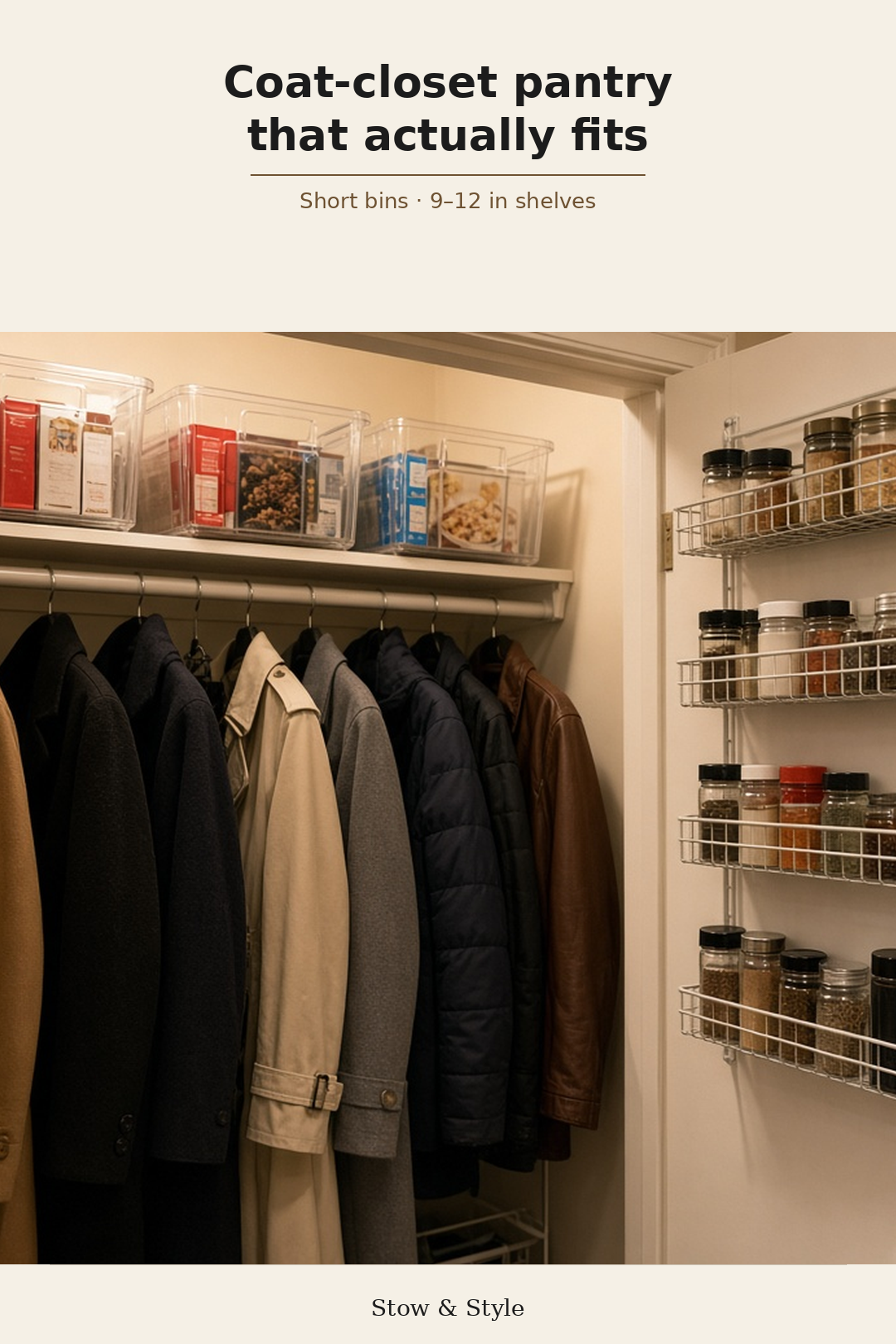
A lot of US apartments do not have a pantry. They have a coat closet beside the kitchen, two wire shelves, and a rod meant for jackets. You can store food there. You cannot store it the way a 16-inch pantry cabinet does.
Deep canisters, deep lazy Susans, and walk-in “pantry organizers” will hang off the front, hit the door, or knock into whatever still hangs on the rod.
The problem
Shallow shelves (often 9–12 inches) plus a door that closes to about an inch of clearance. Add a rod 10–12 inches from the back wall and you have lost the lower volume for anything but hanging bags or a slim cart. The usual failure is buying 13-inch bins because the photo showed “closet.” Those photos are not your closet.
How to measure
- Shelf depth at three points. Wire shelves bow. Measure left, center, right, from back wall to front wire. Use the smallest.
- Door clearance. Close the door on a paperback held on the shelf. If it pinches, your max bin depth is already less than the shelf depth.
- Rod drop. From the underside of the shelf to the rod, and from the rod to the floor. If you still need hanging space, the “pantry” only owns the shelves and the door—not the hanging bay.
- Door interior. Width, height, and hinge side. Note whether the door is hollow-core (most apartment doors are) and whether it clears the frame when you add a rack.
- Outlet and bulb. A closet bulb on a chain is a fire conversation if you stack paper and plastics to the fixture. Keep 8 inches of air around a bare bulb or change the habit, not the lease.
Renter-safe: over-door racks, liners, bins, and a tension rod are reversible. Drilling a closet wall is a deposit conversation. Over-door hardware can scuff paint; use the felt pads in the bag.
Product types
1. Short open bins, 9–10 inch depth class
Not the 14-inch “freezer bin.” Look for exterior depth at or under your smallest shelf number, minus half an inch. Front cutout helps on a high shelf.
Use if: You are corralling packets, rice boxes turned on their side, or snacks that currently lie in a landslide.
Skip if: You insist on storing 13-inch cereal boxes face-out. Turn them sideways or buy the box size that fits. The bin should not overhang to flatter the cereal brand.
2. Over-door pantry rack with shallow baskets
Over-door rack, pantry/spice basket depth
The door is often the only deep-enough vertical real estate. Baskets in the 4–5 inch depth class hold spices, foil, wraps, and cans two-deep if you are careful.
Use if: Shelves are truly shallow and you have a full-height door that does not scrape a tight frame.
Skip if: The door is bi-fold, louvered, or already hits the fridge. Skip also if the rack’s top hooks need a 2-inch gap over the door and your frame is tight—measure the gap between door top and frame. Many 1960s frames have almost none.
Fit caveat: hollow-core doors rattle. A loaded rack can warp a cheap door over a year. Keep weight to cans and spices, not soda cases. Returns happen when hooks do not fit a thick vintage door; check hook gap against door thickness (often 1-3/8 inches).
3. Sideways can rows and a low riser
Narrow can riser or two-tier spice-depth rack
Cans are a friendly 3–4 inches. They are the right inventory for a shallow shelf. A low riser lets you see the back row.
Use if: You actually eat canned food and the back row is currently a mystery.
Skip if: The wire shelf holes do not match the riser’s feet and it rocks. A thin liner plus a riser with a flat base is more honest than a “perfect fit” claim.
4. Slim hanging organizers only if the rod is staying
Fabric shelves that hang from the rod can hold potatoes, onions, or paper goods if you still need some hanging space beside them.
Use if: You will not fight the organizer for coat space every winter.
Skip if: This closet is also the only coat closet. Food and wet raincoats are a bad mix. If winter coats need the rod, skip the hanging organizer.
5. Shelf liner, not a second personality
Bamboo or plastic liner so cans do not ditch into the wire grid. Pick one that can be wiped. Skip adhesive contact paper if you are not allowed to leave residue.
Use if: Anything round lives here.
Skip if: Your shelves are already solid.
Honest limits
A closet pantry will never photograph like a custom butler’s pantry. Sideways boxes, one bin color, and a door rack that does not scrape is a finished project. Do not add a 12-inch lazy Susan to a 10-inch shelf and leave the door open “for now.” Returns for depth are on you if you skip the three-point measurement.
If the rod is in the way of a bin you love, the rod wins until you have written permission to move it. Many leases treat extra closet holes as damage even when you think you improved it.