Pantry
A snack zone in clear bins (without a rainbow wall)
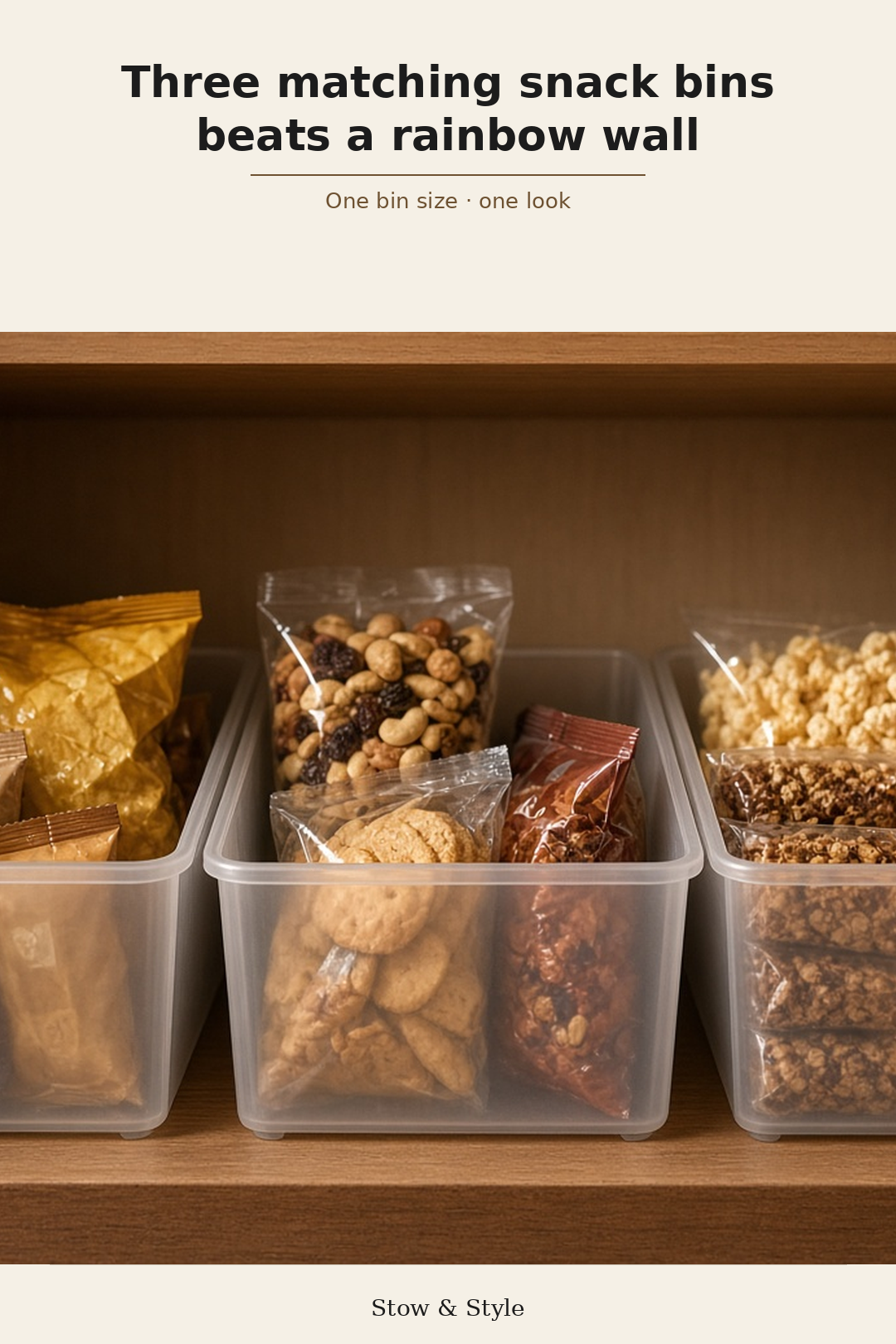
A snack zone is a shelf with rules, not a personality. In an ordinary US apartment it might be the lowest pantry shelf, a crate beside the fridge, or one wire shelf in the closet pantry. People should grab food without detonating a stack of boxes, and you should see when you are out.
Rainbow bins photograph well and look loud in a 30-inch cabinet. Clear, one size, front opening: that is the quiet version.
The problem
Snacks arrive in every geometry: tall chip bags, flat cracker boxes, granola bars in a cardboard sleeve that rips, fruit pouches that slump. If each package is its own citizen, the shelf becomes a landslide. If you buy five different organizers—one for bars, one for applesauce, one “for kids”—you get visual noise and leftover pieces that do not stack.
The other problem is height. A lidded cube that looks tidy on a wide closet shelf will not open under a 9-inch apartment shelf.
How to measure
- Shelf height to the obstruction above. Include the rim of a wire shelf. Subtract the thickness of a liner if you use one.
- Usable depth. Same as every pantry post: back wall to door or front wire. Snack bins with a front opening still have a back wall; that exterior depth must be less than usable depth.
- Reach. If this zone is for children, measure from the floor to the shelf and be honest about who can lift a full bin. A “kid zone” on a high shelf is just a bin you will be asked to fetch.
- Weight. A clear bin full of juice boxes is heavy. If the shelf is particle board with visible sag, fewer items, not a bigger bin.
- Door. Front-open bins need you to pull them or they need to sit with the opening fully in front of the door swing. Measure before you assume you can grab a pouch with the door half open.
Renter-safe: bins sit. No hardware. If you add a tension shelf to create a kid-height zone, use a pole that does not mark the cabinet sides, or stick to an existing low shelf.
Product types
1. Front-open stackable bins, one SKU repeated
Clear front-open bins, identical
Vtopmart-class and similar: one width, one depth, buy two or three, not a mixed pack of four sizes unless those sizes share a footprint.
Use if: Shelf height allows the bin plus your hand at the opening, or the bin can slide out. You want to see inventory.
Skip if: You only snack from two boxes a week. A bin for two boxes is extra plastic. Also skip mixed “variety packs” that include a tiny bin you will not fill.
Fit: check exterior height with the lid or handle if there is one. “Open front” models sometimes still include a tall back. Returns are usually depth and height, not “quality.”
2. Open baskets, metal or clear, no lid
Open pantry baskets, matched pair
Better when shelf height is tight. You lift the bag, not the lid.
Use if: Chip bags and bread-shaped things that hate lids.
Skip if: You have pets or a toddler who treats an open basket as a trough. Then you want a bin with a higher front, or a cabinet that latches—storage will not replace a latch you actually need.
3. Narrow packet file (bars, pouches)
Magazine-file-style packet organizer
Bars and pouches stand like files. Works in a 10-inch depth if you buy the short kind.
Use if: You buy boxes of bars and they currently sprawl.
Skip if: The file is taller than the shelf. Also skip if you mix candy, medicine, and snacks in one file. Medicine does not belong in a snack zone.
4. Small clip set, not a gadget wall
The bin holds the bag; the clip keeps it from going stale. One finish (matte black or clear, not both).
Use if: You actually reseal chips.
Skip if: You are about to buy a “clip with a date window and a pour spout.” That is a different hobby.
Rules that do the work
- One shelf is snacks. The shelf above is not snacks. If cereal is breakfast, it does not live in the snack bin.
- When the bin is full, you do not buy a second style of bin. You stop buying that snack until the bin has air.
- Labels optional; if you label, one typeface (see the label-maker post). “SNACKS” on a rainbow sticker fights the whole point.
Honest caveats
Clear plastic scratches and shows grease. That is still better than opaque bins you have to excavate. Wash with a soft cloth; dishwasher heat can warp cheap PET. If the snack zone is a counter crate, measure depth so it does not hang into a 24-inch galley.
If you live alone, a snack zone is still just a bin for what you grab after 9 p.m. Call it that. Under $50 should cover two matching bins and clips. If a set costs more, buy fewer pieces of the same piece.