Pantry
Spice drawer organization without a 4-inch fantasy
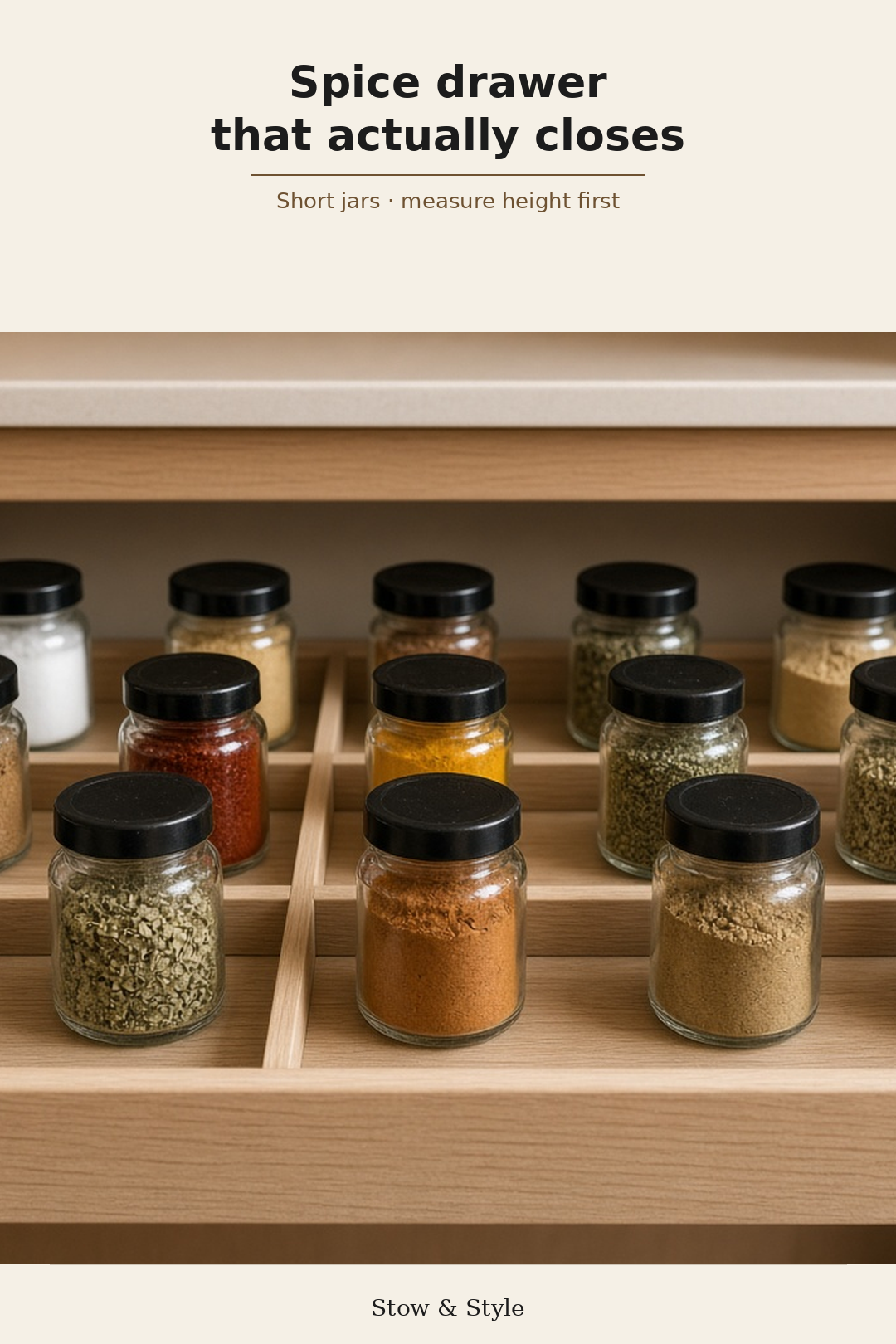
A spice drawer is a good idea until the drawer is 3 inches tall and your “standard” jars are 4.5. Most US apartment kitchens have one junk drawer that could become a spice drawer, plus uppers that already hide four half-used paprikas.
The expensive look is not a custom maple insert. It is bottles you can read without picking up three others, in a tray that does not slide like a sled.
The problem
Two measurements fight each other: jar height (or length, if you lay them down) and drawer clear height (interior bottom to the obstruction above, minus slide hardware). A third number—jar diameter—decides whether a pretty insert wastes half the drawer. People buy an insert sized for 4-inch jars, then own grocery drums, tins, and a tall cumin that never belonged in a drawer.
How to measure
- Clear interior height. Pull the drawer. Measure from the floor of the drawer to the obstruction above at the back as well as the front; some counters drop, some slides sit proud. Write the minimum.
- Interior width and depth. Ignore the face. Measure the box. Subtract a quarter inch so the insert is not a press fit that you will have to destroy later.
- Jar audit. Pick your tallest jar you intend to keep. If you will relabel into one jar type, measure that jar instead, but only if you will actually do the transfer this weekend.
- Lay-down length. If height fails, the drawer may still work with jars on their sides. Measure length of the bottle plus a little for the lid.
- Slide quality. A $12 insert in a sticky particle-board drawer will still stick. If the drawer already racks, fix the slide or pick a cabinet door—do not add weight and hope.
Renter-safe: trays sit. No nails. If you use grip liner, choose a non-adhesive mesh so you are not peeling glue off someone else’s drawer at move-out.
Product types
3–5 types, with skip cases
1. In-drawer tray with adjustable dividers
Expandable in-drawer spice tray
Bamboo or plastic grid that creates rows. Best when all jars are the same height class.
Use if: Clear height is at least 0.5 inch taller than your standing jars, and you own (or will own) one jar diameter.
Skip if: Height is under 3.5 inches and your grocery jars are the tall McCormick-class bottles. They will not fit standing. Do not force the drawer; you will crack the face.
Returns: “expandable” trays often expand in width but not in row depth. If your drawer is 16 inches front-to-back and the tray is 13, you get a junk gap at the back. Measure both axes.
2. Angled in-drawer riser (stair-step)
Stair-step spice riser for drawers
Lets you read labels while jars stand. Needs more height than a flat tray because the back row is elevated.
Use if: You have an unusually deep, tall drawer (some 1990s kitchens do).
Skip if: You are in a typical 3–3.75 inch apartment drawer. The riser is the first thing that will not close. This is the most returned type for a reason.
3. Sideways jar tray (the honest apartment move)
Shallow tray or utensil organizer used sideways
Jars lie down, labels up. A cheap utensil tray in one color often beats a “spice-specific” insert.
Use if: Height failed. You can live with lids pointing left or right in consistent rows.
Skip if: You refuse to relabel lids or caps. Sideways only works if the name faces you. A strip of painter’s tape is allowed; a $40 custom system is not required.
4. Cabinet-door spice clips or a narrow door rack
Over-the-cabinet-door spice rack / adhesive clips
When the drawer is a fantasy, the door is the real estate.
Use if: You have a cabinet beside the stove, a door that clears the shelves inside, and jars under about 4.5 inches tall.
Skip if: The cabinet is packed, the door is thin, or you cook with 8-inch oil bottles you are pretending are spices. Also skip aggressive adhesive on painted MDF if your lease cares about finish. Tension or over-door metal racks are kinder than solvent-level adhesive.
See also the over-door pantry post if the only door you have is the pantry/closet door.
5. Matching jars, small set only
Square or round spice jars, 4 oz class, one lid type
A set of 6–12, not 48. Same lid, same height.
Use if: You will empty grocery bottles once and stop buying random shapes.
Skip if: You are not going to transfer spices this month. Empty decorative jars are clutter. Do not buy a funnel-and-label kit you will not use (the label-maker post is separate and optional).
6. Non-adhesive mesh grip liner (not sticky contact paper)
Non-adhesive mesh grip drawer liner
Beige EasyLiner Select Grip–class mesh: cut-to-fit, non-adhesive, so jars and trays stop skating without leaving glue in a rental drawer. About the low-teens dollar band for a 12 in × 24 ft roll in recent snippets—re-check live.
Use if: The drawer insert slides, jars rotate when the drawer slams, or you want a quiet liner under a sideways tray. Cut slightly undersize so edges do not curl against the face.
Skip if: You were about to buy sticky contact paper or adhesive shelf paper—those leave residue and can peel finish at move-out. Skip if the drawer already has a built-in non-slip texture that works. A liner is not a substitute for fixing a broken slide.
Fit caveat: mesh grip is washable; shake crumbs out rather than scrubbing abrasive cleaners into the weave.
Fit, smell, and returns
- Chili powder stains light wood inserts. Dark or sealed trays hide the first spill.
- Magnetic tins belong on a fridge only if the side is out of the hip-check zone.
- If the drawer slams, jars rotate. A liner helps; a $70 insert will still rotate.
No rental galley drawer needs to look like a cooking-show spice wall. Readable, closable, and one tray color is the finish line.